
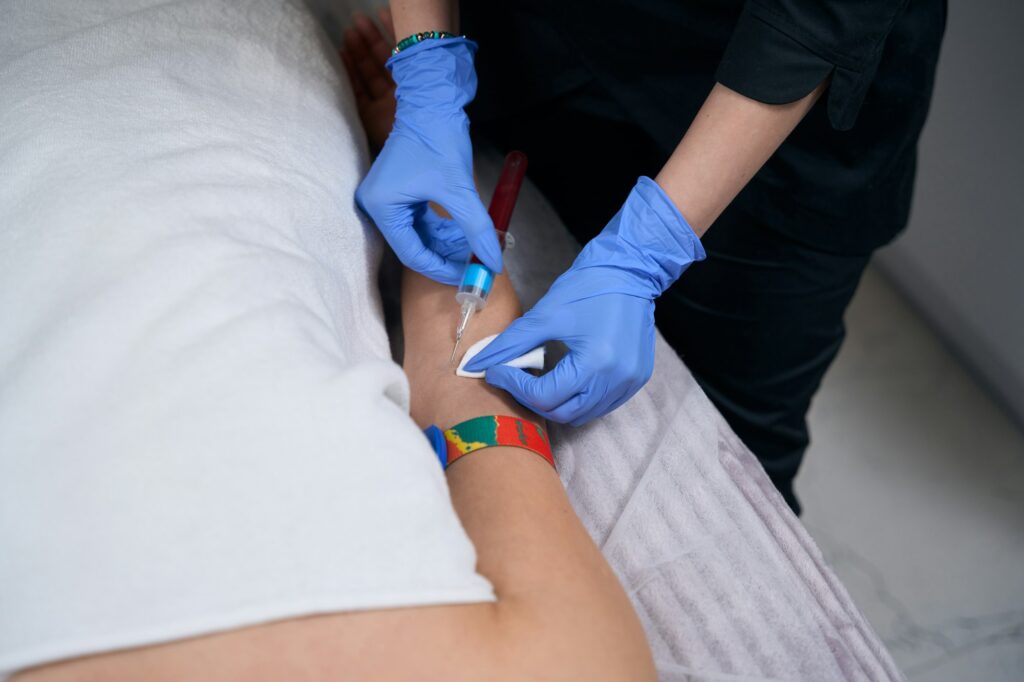
- Non-invasive prenatal testing is done through a blood test. A non-invasive prenatal test (NIPT, for short) may also sometimes be called Non-Invasive Prenatal Screening (NIPS). This is a method used to determine the risk of a fetus being born with certain birth defects.
How does a NIPT or NIPS work?
This test analyzes small fragments of DNA circulating in a pregnant woman's blood. During pregnancy, a mother's blood contains a mixture of cell-free DNA (cfDNA) that comes from both her own cells and cells in the placenta. The placenta is a tissue in the uterus that connects the mother's blood supply to the fetus. Cell-free DNA is a type of DNA that floats freely rather than inside a cell, unlike most DNA that is found inside the nucleus of a cell. Throughout a woman's pregnancy, cell-free DNA often circulates in the mother's bloodstream. These placental cells contain DNA that is usually identical to the fetus's DNA. By analyzing this cell-free DNA from the placenta, expectant mothers have the opportunity to detect certain birth defects early.
How is NIPT administered?
A pregnant woman at 10 to 13 weeks can have a non-invasive prenatal test, using a blood sample. This test poses no risk to the mother or baby. The blood sample is then sent to a laboratory where technicians analyze the results and report the findings back to the gynecologist. Results are expected within 8 to 14 days of being sent.
What abnormalities can NIPT or NIPS detect?
With a non-invasive prenatal test, the risk of disorders including Trisomy 21, also known as Down Syndrome, Trisomy 18 (Edwards Syndrome), and Trisomy 13 (Patau Syndrome) can be determined. Other conditions caused by missing or extra X and Y chromosomes can also be detected with NIPT or NIPS. More advanced NIPTs can be adapted to screen for additional abnormalities.
How accurate are these tests?
NIPT offers more accurate information earlier, while having a low false positive rate. About one in 1,000 people has a false positive rate. Although this test is not 100% accurate and should not be used as a definitive diagnosis for positive cases, a 2016 study found that NIPT has very high sensitivity and specificity for Down syndrome and slightly lower sensitivity for Edwards and Patau. Syndrome. NIPTs are often considered 99% accurate.
Who should have NIPT or NIPS?
There are many women who choose to have the test. Some reasons why you may choose to get an NIPT include:
- The ultrasound raises concerns about the baby's growth or development.
- You are at increased risk due to pregnancy at an older age or have a personal or family history of pregnancy with a chromosomal abnormality.
- You would just like to have more information.
Do you have additional questions about non-invasive prenatal testing?
If you have additional questions about non-invasive prenatal testing, contact our practice today at (+30) 2310 220267 or by completing the relevant contact form.








 English (UK)
  Ελληνικά